Formula Safety 2025: Fragrance-Free, Hypoallergenic, Traceable
Quick Answer
By 2025, the three non‑negotiable pillars of formula safety in skincare and cosmetics are:
Fragrance‑free (or ultra‑low fragrance / allergen‑controlled fragrance)
Hypoallergenic / low sensitization design
Full traceability / supply‑chain transparency
Brands and manufacturers must embed these pillars into every stage — from raw materials to customer communication — to maintain consumer trust, regulatory compliance, and competitive differentiation.
1. Market & Consumer Data That Drive These Trends
| Metric / Trend | Data Point | Implication |
|---|---|---|
| Fragrance‑free skincare market growth | The global fragrance‑free skincare market was valued at ~USD 18.72 billion in 2024 and is projected to reach ~USD 31.45 billion by 2033 (CAGR ~5.9%) (DataHorizzon Research) | Strong consumer demand and room for new entrants |
| Sensitive skin product market size | In 2024, the sensitive skin care products market was valued at USD 42,278 million and expected to reach USD 71,028 million by 2032 (CAGR ~6.7%) (Credence Research Inc.) | Many consumers self-identify as having “sensitive” skin, driving demand for safer formulas |
| Fragrance intolerance prevalence | ~30.5% of general population report being irritated by fragranced products; 1.7‑4.1% show contact allergy to common fragrance mix (Wikipedia) | Even small fragrance components may trigger reactions in a significant subset |
| Case in cosmetics manufacturing | SDB Cosmetics implemented full batch traceability and recipe tracking via manufacturing software to scale operations reliably (Mar-Kov) | Real-world feasibility of integrating traceability even for midsize manufacturers |
| Enterprise traceability example | L’Oréal leveraged DELMIA Apriso to improve product traceability 10× faster and raise “Right First Time” yield from 93.5% to 94.4% (Dassault Systèmes) | Large brands are already investing heavily; smaller brands must catch up or risk lagging |
These data points show that consumers are already voting with their wallets — and brands that do not deliver safety and transparency risk being left behind.
2. Pillar 1: Fragrance‑Free / Ultra‑Low Fragrance — Not Just a Claim
Why fragrance is high‑risk
There are ~2,500 fragrance ingredients used commonly in consumer goods; about 100 are known to elicit reactions in sensitive individuals.
Many consumers report irritation or adverse health reactions to fragranced products — so “unscented / fragrance-free” becomes a strong differentiator.
Spectrum of fragrance strategies
| Strategy | Definition & Use Case | Risk / Trade-off |
|---|---|---|
| True fragrance‑free | No added fragrance or masking agents; ideal for sensitive lines | May reduce consumer aesthetic appeal (some users expect ingredient fragrance) |
| Ultra‑low or allergen‑controlled fragrance | Use fragrance blends with zero or minimal known allergenic markers | Requires strict screening, may still have residual risk |
| Encapsulated or controlled release fragrance | Fragrance bound in microcapsules, releasing slowly or when triggered | More complex formulation, cost, stability challenges |
Example
A skincare brand may offer a “fragrance-free” version of its core serum for sensitive users, while the regular version uses a low-allergen fragrance blend. This dual-offering strategy helps capture both sensitive and mainstream segments.
Best Practices
Use a fragrance screening tool and force ranking of all aroma compounds by sensitization potential.
Always conduct human patch testing to confirm absence of reaction.
Disclose “fragrance” or “aroma” on the label when present, and list any allergenic components clearly.
In marketing, avoid ambiguous claims like “no scent” which may mislead; prefer “fragrance-free” or “ultra-low fragrance”.
3. Pillar 2: Hypoallergenic & Low Sensitization Design
“Hypoallergenic” is often perceived as safer, but the real meaning lies in how much risk reduction the formula achieves.
Key tactics in hypoallergenic design
Ingredient curation / exclusion lists
— Maintain a “no-go list” of high-sensitization preservatives, reactive surfactants, and pro‑oxidant raw materials.
— Use safer alternatives with published sensitization history or low skin reactivity.Concentration safety margins
— Even “safe” actives can cause irritation at high concentrations. Keep buffer zones below known thresholds.
— Use validated toxicology databases, QSAR prediction, literature survey.Stability & degradation control
— Monitor peroxides, oxidation by-products, and breakdown products that may be more active than parent compounds.
— Use antioxidants, chelators, and packaging that minimize light / oxygen exposure.Safety / irritation testing
— Retrospective and prospective HRIPT (Human Repeat Insult Patch Test).
— In vitro assays (e.g. reconstructed human epidermis irritation models).
— Cosmetic “micro‑use” trials in representative consumer cohorts.
— Post‑market tracking of adverse events.
Comparing two hypothetical formulas
| Component | Formula A (Mainline) | Formula B (Sensitive / Hypo) |
|---|---|---|
| Preservative system | Conventional (e.g. parabens + phenoxyethanol) | Low-sensitization blend (e.g. phenoxyethanol alternatives, Euxyl K800, etc.) |
| Fragrance / Aroma | Low-allergen blend 0.5% | No fragrance / masking agents |
| Chelators / Stabilizers | Standard EDTA / BHT | Milder chelators, non‑nitrosamine risk compounds |
| Correction actives / Enhancers | Retinoids, acids at higher concentration | Lower-dose actives, safer delivery systems |
| Patch test result (pilot) | 1–2% subjects mild irritation | <0.5% mild reactivity |
This simplified table helps clients understand that “hypoallergenic” is not a single ingredient swap but a holistic risk‑minimized design process.
4. Pillar 3: Traceability & Transparency — The Backbone of Safety
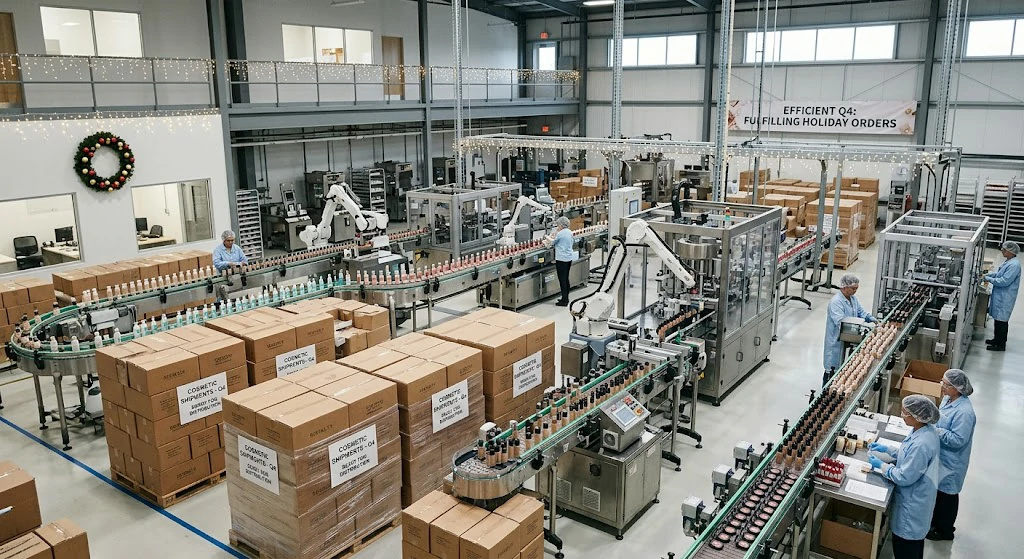
Traceability is what turns safety design from lab promise into market accountability.
What traceability enables
Rapid, targeted recalls (if a raw material issue emerges).
Consumer trust: scanning QR / lot code to verify origin and safety credentials.
Audit readiness with regulators or retailers.
Counterfeit protection and brand integrity.
Real‑world case examples
L’Oréal + DELMIA Apriso: improved traceability and quality, enabling faster root‑cause tracing and boosting “Right First Time” yield.
Shiseido using PLM / Devex: unified development and product record system as a “single source of truth” to maintain alignment across global teams and enforce traceability across formula, packaging, and compliance.
SDB Cosmetics: by adopting contract manufacturing software, they achieved full batch traceability, recipe tracking, and supply transparency.
Implementation approaches
| Layer | Technology / Practice | Remarks |
|---|---|---|
| Supplier contracts & audit | Mandate COAs, origin, full test reports, audit rights | Build trace obligations into contracts |
| Digital tracking systems | ERP, PLM, blockchain / distributed ledger | Enable lineage mapping |
| Unique identifiers | Lot / batch codes, QR codes, NFC tags | Consumers or retailers can query details |
| Data integration | Link raw material, formulation, quality, production, distribution data | A fully integrated view helps in root cause analysis |
| Consumer interface | Web / app decoding of QR, story pages, transparency dashboards | Builds consumer confidence and engagement |
Benefits beyond regulation
Traceability can become a marketing strength: “scan to see origin,” “farm-to-face ingredients.”
Deeper brand loyalty, as consumers feel engaged in the safety narrative. (As noted by traceability thought leadership) (Kezzler)
Reduced waste and supply errors, due to better inventory tracking and visibility.
5. Regulatory & Market Pressures: Why You Can’t Ignore This
EU Regulation (EC) 1223/2009 and updates require mandatory disclosure of fragrance allergens and safety substantiation.
U.S. MoCRA (Modernization of Cosmetics Regulation Act) increases obligations for safety substantiation, adverse event reporting, and registration.
Retailers or e-commerce platforms increasingly require safety dossiers, supplier audits, and traceability certifications before stocking.
Consumers — especially Gen Z and Millennials — value transparency, authenticity, and safety above mere aesthetic or marketing claims.
A single adverse event or traceability failure can damage brand reputation irreversibly in the social media era.
6. Roadmap: From Concept to Market — How Brands & Manufacturers Can Execute
Below is a suggested implementation roadmap (with phases) you can present to clients or internal teams.
| Phase | Focus & Activities | Key Deliverables / Metrics |
|---|---|---|
| Phase I – Strategy & Audit | Audit existing formulas, suppliers, documentation; define “safe formula” framework | Gap analysis, “no-go list,” supplier audit reports |
| Phase II – R&D & Pilot Development | Reformulate key SKUs under fragrance-free & low-sensitization principles; run stability & patch tests | Pilot formula panels, irritation data, stability shelf study |
| Phase III – Trace Infrastructure Setup | Select / integrate PLM / ERP / trace system; define batch coding & digital linkage | Live traceable prototype batches, end-to-end mapping |
| Phase IV – Label & Claim Validation | Legal review of claims (“fragrance-free,” “hypoallergenic,” “traceable”); marketing copy alignment | Approved label language, claim support dossiers |
| Phase V – Pilot Launch & Monitoring | Launch in controlled markets or small runs; collect consumer feedback & track adverse events | Low complaint rates, batch-level feedback mapping |
| Phase VI – Scale & Continuous Improvement | Full commercial launch; continuous data monitoring and iteration | KPI tracking (complaints per million units, rework rates, recall time) |
You may attach a simplified checklist for each client to track status in each phase.
7. How to Present This to Clients / Stakeholders
Use infographics or one‑page visuals to show the three pillars and their interconnections.
Show before vs. after tables of formulas (like the example table above).
Present case studies (L’Oréal traceability, SDB trace implementation) with concrete metrics.
Offer pilot program proposals: e.g. reformulate 1–2 SKUs to a “safe line” and track performance.
Provide consumer messaging templates: e.g. “Scan QR to view ingredient origin & batch safety data.”
8. Conclusion & Next Steps
To make your formulas future‑proof in 2025 and beyond, the trifecta of fragrance-free (or ultra-low fragrance), hypoallergenic / low sensitization design, and full traceability must become the standard operating model — not a marketing add-on.
Recent Post